The Pseudo-Abstraction Coming to Age
Posted:
During my internship at Microsoft last summer, I had the privilege of orchestrating hundreds of AI agents every day (good times with unlimited tokens  ). Yet many of my intern friends and I still ran into our own mini “crises” while using agents on real projects. Those experiences, along with candid conversations with senior researchers, nudged me to write this post.
Coding is not (yet) a solved problem
It’s tempting to look at today’s coding agents and conclude that coding is basically solved. Writing code has become ridiculously fast and cheap. As Ion Stoica pointed out during a panel discussion at HotNets 2026, however, humans aren’t changing at nearly the same speed, so our understanding and reviewing haven’t sped up at all. When an agent spits out thousands of lines in a minute, reading, auditing, and verifying that code quickly turns into the real bottleneck.
Worse, we’re quietly losing ownership of our own projects. Because generation is so effortless, it’s all too easy to skim a diff, hit approve, and move on. Over a few weeks, the intent and design tradeoffs dissolve into sprawling generated artifacts that nobody fully understands. Changes start propagating in ways we neither expect nor understand.
This loss of control happens because we’re treating AI agents like a new programming abstraction, even though they aren’t. Every real abstraction in computer science helps us control complexity. For example, we use procedures to describe computation, data structures to manipulate abstract constructs, types to rule out invalid states, and compilers to translate high-level code into machine instructions. A compiler comes with an explicit semantic contract: once we write valid high-level code, we almost never have to inspect the generated assembly or machine code to make sure it means what we wrote.
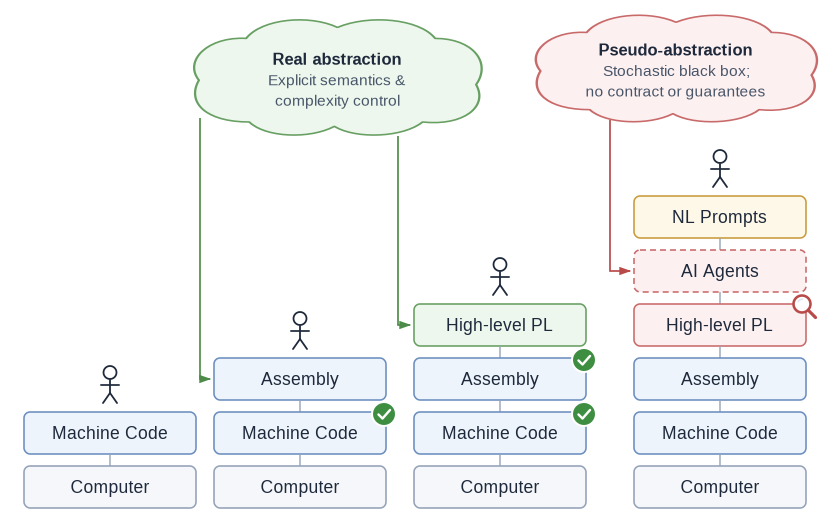
AI agents give us the feeling of sitting one layer higher, typing natural language prompts instead of code. Yet they come with no contract and no guarantee. Under the hood, an agent is a stochastic black box. It doesn’t actually shield us from the layer below; it just produces more code, faster, while leaving us on the hook to read, debug, and reason about it. That lack of guarantees is why I think of it as a pseudo-abstraction.
The pseudo-abstraction requires more than Natural Language
Coding is the process of taking a mental model in our head, funneling it down through our arms and fingers, and turning it into code. Back in 1985, Peter Naur called this process theory building[1]: a program is the living mental theory of how the components fit together, why certain tradeoffs were made, and how the system can safely evolve.
Natural language is a terrible standalone contract for that theory. It’s vague, context-dependent, and massively underspecified. There are simply too many degrees of freedom in how an agent can interpret a prompt.
Traditional programming languages solved complexity by making objects, functions, and types first-class citizens. In an AI-mediated workflow, we need a compact, human-owned layer where intents, invariants, objectives, and design tradeoffs are first-class citizens. An untrusted AI can then handle the implementation while a small trusted checker decides what gets accepted.
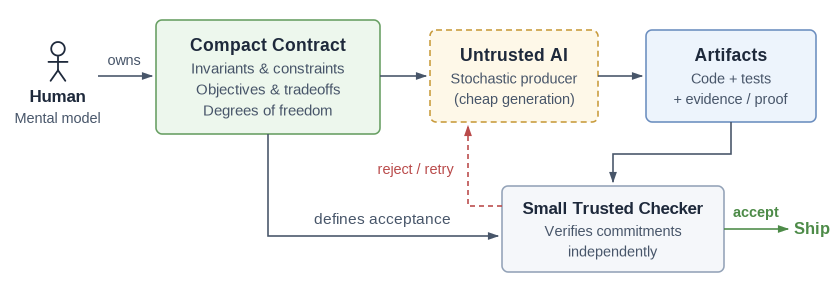
A lot of smart people are already pushing on pieces of this puzzle, though each approach has its limitations:
- Workflows, prompts, and skills: Agent orchestration frameworks help structure tool calls and multi-step loops, but they offer no semantic contract over the generated code. They’re hard to evaluate rigorously and tend to go obsolete the moment a stronger model or agent harness drops.
- Verified compilers, Proof-Carrying Code, and vericoding: Classic ideas like CompCert[2] and Proof-Carrying Code (PCC)[3], alongside newer LLM-driven efforts like AlphaVerus[4] and vericoding[5], take advantage of a great asymmetry: generating code and proofs is hard, while checking them is cheap. However, humans still have to write the spec, and formal specs are notoriously dense and hard to read. Checking whether a spec actually matches what we wanted is an inherently semantic judgment that no proof can settle.
- Intent formalization: Intent formalization is the direction I find most exciting. Recent work by Shuvendu K. Lahiri frames it as a grand challenge for reliable AI coding: helping humans interactively turn messy intent into checkable specifications.[6] Ideas like mutation coverage[7] can then probe spec quality so blind spots surface early.
Immense power under ambiguity and uncertainty
For all its ambiguity, natural language is also insanely powerful. If we’re honest, traditional source code is usually a pretty lousy representation of our mental model. Code works fine as an executable machine, yet it fails as a theory: the rationale, assumptions, and tradeoffs stay buried under boilerplate and control flow.[1] Natural language lets us express what we actually care about much more freely and naturally.
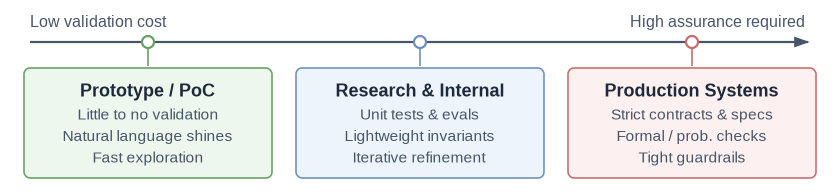
Validation isn’t black and white either. We don’t need formal proofs for everything; validation sits on a spectrum depending on what we’re building:
- Prototypes and PoCs: Little to no validation is totally fine. Natural language and fast iteration shine here.
- Research and internal tools: Tests, evals, and lightweight invariants are typically enough.
- Production and critical systems: High assurance demands strict contracts, verifiers, and tight guardrails.
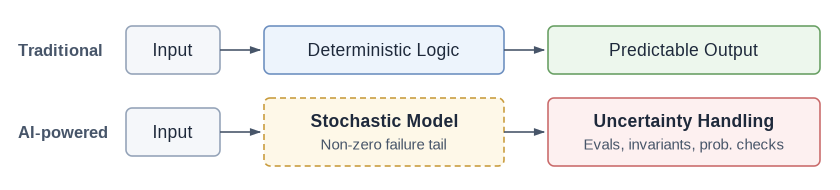
Beyond building software with AI, running AI inside software is a whole different beast because of uncertainty. As Andrew Ng put it, the core difference between traditional software and AI applications is that AI outputs are inherently unpredictable.[8] An AI component is non-deterministic; with some non-zero probability, it can emit an unexpected output at any time and break a downstream system in ways that are hard to anticipate. Learning how to measure, bound, and handle that uncertainty is the heart of building real AI applications.
It’s been really energizing to see the networking community lean right into this challenge. At HotNets 2026, many papers tackled uncertainty, measurement limits, and probabilistic reasoning head-on: from automated probabilistic reasoning for network performance analysis[9] and self-validating uncertainty when ground truth is unaffordable,[10] to heuristic rediscovery as a litmus test for RL in networked systems[11] and the observer effect in Internet measurement.[12] My own HotNets paper, Autogram, takes a related angle by pairing a non-deterministic LLM that proposes a grammar with a statistics-driven search that produces auditable, formally checkable network invariants.[13]
Why we’re not out of a job yet
I’ll admit I’m a bit worried about where these shifts are heading, yet I’m even more excited. AI is shrinking the gap between my wildest imagination and what I can actually build in an afternoon.
What we’re living through feels like a quiet shift in what computer science is even about. Hal Abelson contrasted mathematics with computer science.[14] Mathematics deals with declarative knowledge about “what is true,” much like geometry, whereas computer science has historically focused on imperative “how-to” knowledge using procedures to manage processes. As AI takes over more of the “how-to,” our job is shifting back toward “what is true”: objectives, invariants, and design tradeoffs.

Even with hundreds of agents at my fingertips, I noticed something funny this past year: almost all of my best ideas and breakthroughs still came from talking with actual humans. Agents can amplify execution, but figuring out what is worth building still happens over coffee and whiteboards.
As I briefly wrote in my previous post, I believe complexity is what gives rise to intelligence, artificial or not. Melanie Mitchell explains that complexity inevitably brings emergent behaviors we can’t predict just by staring at individual components.[15] We’re already grappling with these emergent phenomena in modern cloud infrastructure, where subtle, unnoticed bugs snowball in unexpected and sometimes incomprehensible ways into massive cascading outages at Microsoft,[16, 17] AWS,[18] and Cloudflare.[19]
As we use powerful AI to build even larger, more complex systems, managing the emergent consequences of both the AI and the systems it creates will be the next big battlefield. So no, I don’t think we’re running out of work anytime soon ;)
References
- [1] Peter Naur, "Programming as Theory Building," Microprocessing and Microprogramming, 15(5):253–261, 1985.Back to citation 1 · Back to citation 2
- [2] Xavier Leroy, "Formal verification of a realistic compiler," Communications of the ACM, 52(7):107–115, 2009.Back to text
- [3] George C. Necula, "Proof-Carrying Code," ACM POPL, 1997.Back to text
- [4] Pranjal Aggarwal, Bryan Parno, and Sean Welleck, "AlphaVerus: Bootstrapping Formally Verified Code Generation through Self-Improving Translation and Treefinement," ICML, 2025.Back to text
- [5] Bursuc et al., "A benchmark for vericoding: formally verified program synthesis," arXiv:2509.22908, 2025.Back to text
- [6] Shuvendu K. Lahiri, "Intent Formalization: A Grand Challenge for Reliable Coding in the Age of AI Agents," arXiv:2603.17150, 2026.Back to text
- [7] Hana Chockler, Orna Kupferman, and Moshe Y. Vardi, "Coverage metrics for formal verification," International Journal on Software Tools for Technology Transfer (STTT), 8(4–5):373–386, 2006.Back to text
- [8] Andrew Ng, "The AI Engineering Skills Map," The Batch (DeepLearning.AI), August 2026.Back to text
- [9] Jamie Kai, Rachee Singh, and Mina Tahmasbi Arashloo, "The Case for Automated Probabilistic Reasoning for Network Performance Analysis," ACM HotNets, 2026.Back to text
- [10] Fabián E. Bustamante, Santiago Klein, Caleb Wang, Kedar Thiagarajan, and Ying Zhang, "Self-Validating Uncertainty: Or, How to Do Measurement When You Cannot Afford Ground Truth," ACM HotNets, 2026.Back to text
- [11] Seoyul Oh, Yikai Zheng, Eric Xiang Gao, Deepak Vasisht, and Francis Y. Yan, "Rediscovering Heuristics: A Litmus Test for RL in Networked Systems," ACM HotNets, 2026.Back to text
- [12] Abbas Mohsenpour and Cristel Pelsser, "The Observer Effect in Internet Measurement: A Case Study of Route Origin Validation," ACM HotNets, 2026.Back to text
- [13] Hongyu Hè, Alexander Krentsel, Sylvia Ratnasamy, and Maria Apostolaki, "Invariant Discovery for Networked Systems," ACM HotNets, 2026.Back to text
- [14] Harold Abelson and Gerald Jay Sussman (with Julie Sussman), Structure and Interpretation of Computer Programs (2nd ed., MIT Press, 1996).Back to text
- [15] Melanie Mitchell, Complexity: A Guided Tour (Oxford University Press, 2009).Back to text
- [16] Computerworld, "Microsoft outage: A cascading failure that started with an undetected bug," November 2026.Back to text
- [17] ThousandEyes, "Microsoft Azure Front Door Outage Analysis: October 29, 2025," October 2025.Back to text
- [18] Akamai, "When the Cloud Breaks: Lessons from the AWS Outage," October 2025.Back to text
- [19] The Cloudflare Blog, "Cloudflare outage on November 18, 2025," November 2025.Back to text
Leave a comment